JetZone.
A flight-search app that tests 100+ date combinations per search, because the cheap fare is usually two days left or right of the one you asked for.
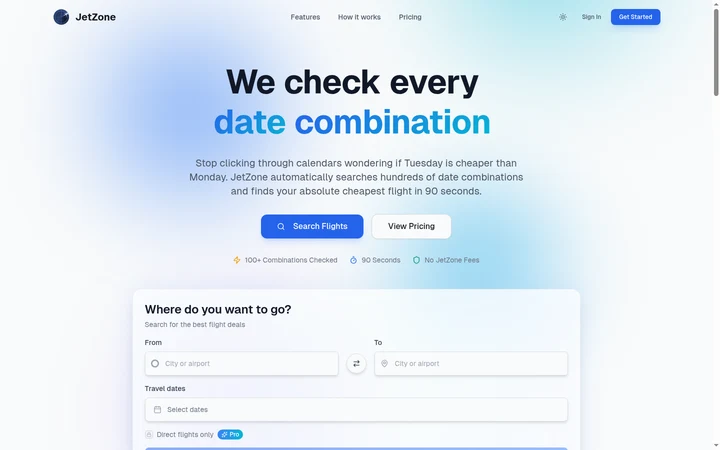
Exhibit Ajetzone.io — live search
The cheap flight hides two days away.
Airline sites and aggregators price the exact dates you type in. But shifting a trip by a day or two routinely changes the fare by hundreds of dollars, and finding that out by hand means running dozens of searches, one date pair at a time, for hours.
The job: automate the whole matrix. Take an origin, a destination, and a flexible range, and check every sensible departure-and-return combination without the user doing anything twice.
Fresh data or no product.
Flight-data APIs exist, and the affordable ones return stale or partial fares. For a price-comparison product, that is worse than nothing.
So JetZone drives real searches instead: browser automation running the same queries a person would, managed by a queue so a hundred combinations resolve in a stream instead of a pile-up.
A “deal” the airline won’t honor teaches the user to distrust the tool in one use.
A search matrix with a patient engine.
The frontend is Next.js: a search form that takes flexible dates, then a results grid that fills in live. Server-sent events push each fare to the page as it lands, so you watch the matrix populate instead of staring at a spinner.
Behind it, a Python search service runs the automated queries, with concurrent sessions, rotation for reliability and a Redis-backed queue pacing the work. Results land in PostgreSQL with deduplication, then sort by price, duration, or airline.
It uses the same engineering as an internal tool, with the interface held to the standard people expect from products they didn’t have to buy.
Live, and staying that way.
Next.js Python PostgreSQL Redis Tailwind CSS